 start
start
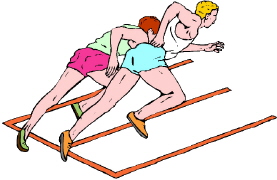
start [start starts started starting] verb, noun BrE [stɑːt] NAmE [stɑːrt]
verb
DOING STH
1. transitive, intransitive to begin doing or using sth
•~ sth I start work at nine.
• He's just started a new job.
•I only started (= began to read) this book yesterday.
•We need to start (= begin using) a new jar of coffee.
•The kids start school next week.
•~ to do sth It started to rain.
•Mistakes were starting to creep in.
•~ doing sth She started laughing.
•~ (on sth) It's a long story. Where shall I start?
•It's time you started on your homework.
•Can you start (= a new job) on Monday?
•~ by doing sth Let's start by reviewing what we did last week.
•+ adj. The best professional musicians start young.
HAPPENING
2. intransitive, transitive to start happening; to make sth start happening
• When does the class start?
• Have you any idea where the rumour started?
•~ sth Who started the fire?
•Do you start the day with a good breakfast?
•You're always trying to start an argument.
•~ sb/sth doing sth The news started me thinking.
MACHINE/VEHICLE
3. transitive, intransitive ~ (sth) when you start a machine or a vehicle or it starts, it begins to operate
• Start the engines!
• I can't get the car started.
•The car won't start.
EXISTING
4. intransitive, transitive to begin to exist; to make sth begin to exist
•~ (up) There are a lot of small businesses starting up in that area.
•~ sth (up) They decided to start a catering business.
•She started a yoga class at work.
JOURNEY
5. intransitive ~ (out) to begin a journey; to leave
Syn: ↑set off, Syn: ↑set out
• What time are we starting tomorrow?
GOING/WALKING
6. intransitive + adv./prep. to begin to move in a particular direction
• I started after her (= began to follow her) to tell her the news.
•He started for the door, but I blocked his way.
IN PARTICULAR WAY/FROM PLACE/LEVEL
7. intransitive, transitive to begin, or to begin sth such as a career, in a particular way that changed later
•~ as sth She started as a secretary but ended up running the department.
•~ out/off (as sth) The company started out with 30 employees.
•~ sth (as sth) He started life as a teacher before turning to journalism.
8. intransitive + adv./prep. to begin from a particular place, amount or situation
• The trail starts just outside the town.
• Hotel prices start at €50 a night for a double room.
•The evening started badly when the speaker failed to turn up.
MOVE SUDDENLY
9. intransitive to move suddenly and quickly because you are surprised or afraid
Syn: ↑jump
•The sudden noise made her start.
more at alarm bells ring/start ringing at ↑alarm n., get/set/start/keep the ball rolling at ↑ball n., get/start off on the right/wrong foot at ↑foot n.
Verb forms: 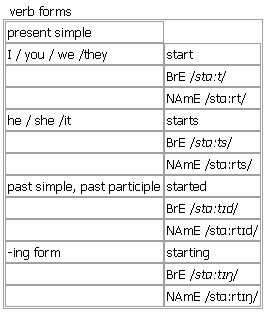
Word Origin:
Old English styrtan ‘to caper, leap’, of Germanic origin; related to Dutch storten ‘push’ and German stürzen ‘fall headlong, fling’. From the sense ‘sudden movement’ arose the sense ‘initiation of movement, setting out on a journey’ and hence ‘beginning of a process, etc.’.
Thesaurus:
start verb
1. T, I
•He's just started a new job.
begin • • open • • take sth up • • set about sth • • go about sth • • set sth up • • set/put sth in motion • |formal commence • • embark on/upon sth • • initiate • • institute • |especially business journalism launch •
Opp: finish, Opp: stop
start/begin/take up/set about/go about/commence doing sth
start/begin to do sth
start/begin/open/embark on/initiate/institute/launch a/an campaign/inquiry
start/begin/set in motion/embark on/initiate/institute/set up/launch a scheme
Start or begin? Compare:
•‘Ladies and gentlemen,’ he began.
✗ ‘Ladies and gentlemen,’ he started.:
•Who started the fire?
• I can't start the car
✗ Who began the fire?
• ✗ I can't begin the car.
2. I
•When does the class start?
begin • • start off • • open • |informal kick off • |formal commence •
Opp: finish
start/begin/start off/open/kick off/commence with sth
start/begin/start off/open/kick off/commence by doing sth
a campaign/competition/match/meeting starts/begins/starts off/opens/kicks off/commences
a film/book/chapter starts/begins/starts off/opens
3. T, I
•Start the engines!
start sth up • • turn sth on • • switch sth on •
Opp: stop
start/start up/turn on/switch on a machine/motor/engine
start/turn on/switch on the ignition
Start or start up? Only start is used in the phrases get sth started and sth won't start. Use start sth up to talk about computers.
4. I
•They started out early for Saigon.
set off • • take off • • set sail • • leave • |formal depart • |especially written set out •
start/set off/take off/set sail/leave/depart/set out for/from sth
start (out)/set off/take off/set sail/set out on a journey, voyage, etc.
start/set off/take off/leave/depart/set out early
Synonyms:
start
begin • start off • kick off • commence • open
These words are all used to talk about things happening from the beginning, or people doing the first part of sth.
start • to begin to happen or exist; to begin in a particular way or from a particular point: ▪ When does the class start?
begin • to start to happen or exist; to start in a particular way or from a particular point; to start speaking: ▪ When does the concert begin?
start or begin?
There is not much difference in meaning between these words. Start is more frequent in spoken English and in business contexts; begin is more frequent in written English and is often used when you are describing a series of events: ▪ The story begins on the island of Corfu. Start is not used to mean ‘begin speaking’: ‘Ladies and gentlemen,’ he started.
start off • (rather informal) to start happening or doing sth; to start by doing or being sth: ▪ The discussion started off mildly enough.
kick off • (informal) to start an event or activity, especially in a particular way; (of an event, activity, etc.) to start, especially in a particular way: ▪ Tom will kick off with a few comments. ◇ ▪ The festival kicks off on Monday, September 13.
commence • (formal) to start happening: ▪ The meeting is scheduled to commence at noon.
open • to start an event or activity in a particular way; (of an event, film/movie or book) to start, especially in a particular way: ▪ The story opens with a murder.
to start/begin/start off/kick off/commence/open with sth
to start/begin/start off/kick off/commence/open by doing sth
to start/begin/start off/commence as sth
a campaign/season/meeting starts/begins/starts off/kicks off/commences/opens
a film/movie/book starts/begins/starts off/opens
Which Word?:
begin / start
There is not much difference in meaning between begin and start, though start is more common in spoken English: ▪ What time does the concert start/begin? ◇ ▪ She started/began working here three months ago. Begin is often used when you are describing a series of events: ▪ The story begins on the island of Corfu. Start, but not begin, can also mean ‘to start a journey’, ‘to start something happening’ or ‘to start a machine working’: ▪ We’ll need to start at 7.00. ◇ ▪ Who do you think started the fire? ◇ ▪ The car won’t start.
You can use either an infinitive or a form with -ing after begin and start, with no difference in meaning: ▪ I didn’t start worrying/to worry until she was 2 hours late.
After the forms beginning and starting, the -ing form of the verb is not normally used: ▪ It’s starting/beginning to rain. ◇ It’s starting/beginning raining.
Example Bank:
•A new term was about to start.
•At that point I just started to hate the man.
•By early evening he was ready to start work.
•He has just started at school.
•Her heart suddenly started to race.
•I'll have to start again from scratch.
•I've finished decorating the bathroom, so now I can start on the bedroom.
•If you want to learn about frogs, this book is an excellent place to start.
•It started as a hobby and grew from there.
•It's already late, so I think we should get started.
•It's time to start thinking about next year.
•Let's start with this first piece of music.
•She started up a conversation with the woman sitting next to her.
•Start from the beginning and tell me exactly what happened.
•We'll just have to start all over again.
•We'll start off by doing some warm-up exercises.
•Work is due to start this weekend.
•You'd better start packing if you're to leave early tomorrow morning.
•He's just started a new job.
•Hotel prices start at £65 a night for a double room.
•I only started this book yesterday.
•It's time you started on your homework.
•We need to start a new jar of coffee.
•You're always trying to start an argument.
•I can't get the car started.
•I should get there by the afternoon if I start early.
•Make sure you've got everything before we start.
•She had started out late for the meeting.
•The car won't start.
•They had started out from Saigon the previous day.
•They started out at five o'clock in the morning.
•What time do we start?
Idioms: ↑don't start ▪ ↑for a start ▪ ↑get started ▪ ↑start something ▪ ↑start with ▪ you/he/she started it
Derived: ↑start back ▪ ↑start off ▪ ↑start on about something ▪ ↑start on at somebody ▪ ↑start on somebody ▪ ↑start out ▪ ↑start over ▪ ↑start somebody off ▪ ↑start something up ▪ ↑start up
noun
BEGINNING
1. countable, usually singular the point at which sth begins
•a perfect start to the day
• Things didn't look too hopeful at the start of the year.
• If we don't hurry, we'll miss the start of the game.
•The meeting got off to a good/bad start (= started well/badly).
•The trip was a disaster from start to finish.
•We've had problems (right) from the start.
• (informal)This could be the start of something big.
2. singular the act or process of beginning sth
• I'll paint the ceiling if you make a start on the walls.
• I want to make an early start in the morning.
•She's moving abroad to make a fresh start (= to begin a new life).
see also ↑false start, ↑kick-start
OPPORTUNITY
3. countable, usually singular the opportunity that you are given to begin sth in a successful way
• They worked hard to give their children a good start in life.
• The job gave him his start in journalism.
IN RACE
4. the startsingular the place where a race begins
•The runners lined up at the start.
5. countable, usually singular an amount of time or distance that sb has as an advantage over other people at the beginning of a race
•She went into the second round with a five-minute start on the rest of the cyclists.
•I gave the younger children a start.
see also ↑head start
6. countable, usually plural (sport)a race or competition that sb has taken part in
•She has been beaten only once in six starts.
SUDDEN MOVEMENT
7. countable, usually singular an act of moving your body quickly and suddenly because you are surprised, afraid, etc
•She woke from the dream with a start.
•You gave me quite a start!
more at by/in fits and starts at ↑fit n., get off to a flying start at ↑flying start
Word Origin:
Old English styrtan ‘to caper, leap’, of Germanic origin; related to Dutch storten ‘push’ and German stürzen ‘fall headlong, fling’. From the sense ‘sudden movement’ arose the sense ‘initiation of movement, setting out on a journey’ and hence ‘beginning of a process, etc.’.
Thesaurus:
start noun C, usually sing.
•We'll miss the start if we don't hurry.
beginning • • opening • • birth • |formal outset • • onset • |literary dawn • |(in football)kick-off •
Opp: finish
at the start/beginning/opening/outset/onset/birth/dawn (of sth)
from the (very) start/beginning/outset
mark the start/beginning/opening/onset/birth/dawn (of sth)
Start or beginning? Compare:
•We missed the beginning of the movie (= the first few scenes).
• We'll miss the start of the game (= the moment when it starts; the kick-off).
• from start to finish
• from beginning to end
✗ from start to end
• ✗ from beginning to finish
:
•the beginning/start of the day/week/year/century/a new era
• at the beginning of July/summer /the 90s
✗ at the start of July/summer/the 90s:
•I want to make an early start
✗ I want to make an early beginning.
Example Bank:
•All parents want to give their kids a head start in life.
•Despite a bright start, Liverpool lost the match.
•Despite a promising start, we lost the game.
•Everyone was in a conciliatory mood at the start of the meeting.
•He joined the team prior to the start of the season.
•I clicked the icon in the start menu.
•I think it's time we made a start.
•Moving to a good school gave Sally a fresh start in life.
•She felt at home in her new job right from the start.
•The company got off to an impressive start this year.
•The fine winter weather heralded a good start to the year.
•The project was doomed from the start.
•The runners walked up to the start line.
•The space project went from a standing start to the moon in ten years.
•This is a thoroughly good book from start to finish.
•right from the very start
•I'll paint the ceiling if you make a start on the walls.
•If we don't hurry, we'll miss the start of the game.
•She's moving abroad to make a fresh start.
•The meeting got off to a good/bad start.
•The trip was a disaster from start to finish.
•They worked hard to give their children a good start in life.
•We've had problems (right) from the start.
•What a perfect start to the day!
|
|
